
Ziyoda Rizaeva, Center for Economic Research and Reforms
The global economy is developing amid the restructuring of global supply chains. At the same time, the role of regional formats capable of creating additional opportunities for trade, investment, and industrial cooperation is increasing.
One such format is the Shanghai Cooperation Organization (SCO), which marks its 25th anniversary in 2026. Over the past quarter-century, the organization has significantly expanded its membership, geographical reach, and areas of cooperation, while accumulating considerable experience in multilateral and economic cooperation and developing substantial resource and transport potential.
For Uzbekistan, cooperation within the SCO is important for expanding trade, investment, industrial, and transport ties.
The Growing Importance of the SCO
Over the past quarter-century, the SCO has undergone substantial institutional development. Established in 2001 by six countries, the organization today comprises 10 member states (Kyrgyzstan, China, Russia, Kazakhstan, Tajikistan, Uzbekistan, India, Pakistan, Iran, and Belarus). India and Pakistan joined the SCO in 2017, Iran became a full member in 2023, and Belarus in 2024. The Organization has 17 partner states, including Azerbaijan, Mongolia, and Afghanistan.
Guided by its fundamental principles, the SCO serves as a reliable guarantor of stability and security in the region, particularly in Central Asia. Amid a rapidly changing international environment and persistent instability, this role of the Organization is becoming increasingly important.
The SCO is neither bloc-based nor confrontational in nature and remains open to cooperation. This clearly demonstrates that its activities are not directed against the interests of other countries or international organizations.
All decisions within the SCO are made by consensus and require the full agreement of all member states. This principle ensures that the interests of every participant are taken into account, guarantees equality among member states, and enhances the Organization’s appeal as a platform for multilateral cooperation.
Today, the SCO member states cover more than 65% of Eurasia’s territory. Their combined population is around 3.4 billion people, or more than 42% of the world’s population. The combined nominal GDP of the SCO countries exceeds $26 trillion, accounting for around one-quarter of the global economy. In purchasing power parity terms, the organization’s member states account for more than one-third of global GDP.
In 2025, the combined economic growth of the SCO countries was around 5%, compared with global growth of 3.4%. The member states differ in terms of economic size, production structure, resource endowment, competitive advantages, and degree of market openness. This diversity creates broad opportunities for specialization, industrial cooperation, and economic complementarity.
The SCO countries possess substantial energy and mineral resources, a developed industrial base, and growing consumer markets. According to calculations based on international energy statistics, the organization’s member states account for around 69% of global coal production and approximately 30% of natural gas production. Their resource endowment and market capacity create favorable conditions for implementing major industrial, energy, and infrastructure projects.
Between 2015 and 2024, intra-SCO trade (exports) increased almost 2.5-fold, from $271 billion to $674 billion. Over the same period, its share in the countries’ combined foreign trade increased from 8.9% to 14.2%.
The expansion of trade ties is being supported by the development of transport routes, digitalization of trade procedures, and the increasingly widespread use of national currencies in mutual settlements.
An important milestone in the SCO’s institutional development was the 2025 Tianjin Summit, where the SCO Development Strategy through 2035 was adopted. The document defined long-term priorities for multilateral cooperation. Of particular importance was the decision to establish the SCO Development Bank, which is expected to expand financing opportunities for regional infrastructure and investment projects.
Uzbekistan and the SCO in the System of Economic Relations
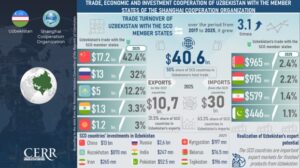
Uzbekistan’s foreign economic relations with the SCO countries have intensified considerably in recent years. According to estimates by the Center for Economic Research and Reforms, between 2017 and 2025, trade turnover increased 3.1-fold, from $12.9 billion to $40.6 billion. Exports grew nearly 1.8-fold, from $5.8 billion to $10.65 billion, while imports increased 4.2-fold, from $7.1 billion to $29.96 billion.
As a result, in 2025 the SCO countries accounted for around half of Uzbekistan’s total foreign trade turnover, including 31.5% of the country’s exports and 63.3% of its imports.
Geographically, the bulk of trade is concentrated in China, Russia, and Kazakhstan. In 2025, Uzbekistan’s trade turnover with China reached $17.2 billion, with Russia $13 billion, and with Kazakhstan $5 billion. Together, these three countries accounted for around 87% of Uzbekistan’s trade with SCO member states.
Trade with India reached $1.3 billion, followed by Kyrgyzstan at $1.2 billion, Belarus at $965 million, Tajikistan at $912 million, Iran at $579 million, and Pakistan at $446 million.
The SCO countries are major markets for Uzbek fruit and vegetables and other food products, textiles, electrical goods, and automotive products.
A significant share of imports from SCO countries consists of machinery and equipment, industrial goods, raw materials, and food products used by Uzbekistan’s domestic market and manufacturing sector.
The existing trade structure demonstrates Uzbekistan’s high level of economic interconnectedness with SCO countries.
Investment and Industrial Cooperation within the SCO
Further development of trade between Uzbekistan and the SCO member states creates a foundation for deeper investment and industrial cooperation. For Uzbekistan, particular interest lies in moving toward joint ventures, localization of technological processes, and the development of industrial cooperation between enterprises across SCO countries.
In 2025, the volume of foreign investment and loans in fixed capital in Uzbekistan amounted to $33.5 billion. Manufacturing accounted for 33.2% of the total, electricity and gas supply for 17.1%, and mining for 11.9%. The structure of investment indicates significant potential for further development of industrial cooperation, joint production, and localization of technological processes.
SCO member states occupy a significant place in Uzbekistan’s investment cooperation. In 2025, investment from the Organization’s member states amounted to $17.5 billion. The largest volumes came from China ($13 billion) and Russia ($2.6 billion). Other partners included Kazakhstan ($870 million), Iran ($265 million), India ($247 million), Kyrgyzstan ($197 million), Tajikistan ($196 million), Belarus ($76.5 million), and Pakistan ($52.5 million).
Facilitating mutual trade, harmonizing standards, developing production and logistics chains, and promoting mutual investment were identified by President of the Republic of Uzbekistan Shavkat Mirziyoyev at the 2025 Tianjin Summit as priority areas of economic cooperation within the SCO. To promote direct business dialogue, the President proposed holding an annual “SCO Invest” Investment Forum.
The initiative received practical follow-up as early as 2026. During Kyrgyzstan’s SCO chairmanship, the SCO Investment and Business Forum was held in Bishkek on June 24–25 with representatives of the organization’s member states. The forum covered investment and trade and economic cooperation, industrial and technological cooperation, the digital economy, artificial intelligence, e-commerce, and new industrialization.
Another area of industrial cooperation involves utilizing the resource potential of SCO countries. Uzbekistan’s initiative to establish an SCO Regional Center for Critical Materials provides for cooperation in modern technologies for the extraction and deep processing of mineral resources. The proposed SCO Energy Consortium is aimed at developing joint energy projects. Uzbekistan has also proposed establishing a network of venture companies and funds to support innovative projects.
For Uzbekistan, these new cooperation formats within the SCO expand opportunities for attracting investment and technology, localizing production, and increasing the output of high-value-added products.
Transport Connectivity and New Routes
Transport cooperation occupies one of the most important places in Uzbekistan’s trade and economic relations with SCO countries. According to estimates by the Center for Transport and Logistics Development Studies, over the past five years the volume of international freight transportation with the organization’s member states increased by 40%, or 9 million tonnes, reaching 33.5 million tonnes in 2025. SCO countries account for around 80% of Uzbekistan’s international freight transportation, with the largest volumes involving Russia, Kazakhstan, China, and Kyrgyzstan. According to Uzbekistan’s Ministry of Transport, freight transportation with SCO countries could reach 47 million tonnes by 2030.
Growing freight flows are increasing the importance of new routes connecting East, Central, and South Asia. The 2025 Tianjin Declaration provides for further cooperation along the North–South and East–West corridors, the establishment and modernization of international transport routes, greater use of the transit potential of SCO member states, and the digitalization of logistics procedures.
One of the most significant projects for Uzbekistan is the China–Kyrgyzstan–Uzbekistan railway, construction of which began in December 2024. The new route is expected to shorten the distance from East Asia toward the Middle East and Southern Europe by around 900 km, while reducing delivery times by 7–8 days. Potential freight volumes are estimated at 12–15 million tonnes per year (Ministry of Transport of Uzbekistan).
Another important route is the Uzbekistan–Afghanistan–Pakistan railway. In July 2025, the parties signed a framework intergovernmental agreement on preparing its feasibility study. Linking the two railway projects would make it possible to create a continuous route from China through Central Asia and Afghanistan to Pakistan and the ports of the Indian Ocean.
Infrastructure projects are complemented by efforts to optimize railway transportation conditions. At Uzbekistan’s initiative, the creation of an SCO Council for the Integration of Railway Networks is being considered, with the aim of reducing physical and administrative barriers and improving the connectivity of member states’ railway systems.
For Uzbekistan, the development of new transport corridors expands access to the markets of Eurasia and South Asia and strengthens the country’s potential as a transit hub between the SCO’s major economic centers.
New Areas of Cooperation
The expansion of economic interaction within the SCO is accompanied by the emergence of new areas for joint work. Scientific and technological cooperation, energy, environmental protection, food security, education, and tourism are already part of the organization’s sectoral cooperation framework, while a number of recent initiatives are aimed at creating practical mechanisms in these areas.
One promising area remains scientific and technological cooperation. At the 2025 Tianjin Summit, Uzbekistan proposed creating an “SCO Network of Innovation and Technology Hubs” to generate new ideas and facilitate technology transfer. Artificial intelligence, big data, robotics, bioengineering, and alternative energy were identified among the priority areas.
Considerable potential is concentrated in energy and the green transition. According to China’s National Energy Administration, by the end of 2024 the total installed renewable energy capacity in SCO countries had reached 2.31 billion kW, increasing 14.5-fold compared with 2001 and accounting for around half of the global total. In 2025, SCO countries adopted a Statement on Cooperation in the Field of Green Industry. Uzbekistan also proposed establishing an SCO Energy Consortium and a Regional Platform on climate adaptation, decarbonization, and the use of artificial intelligence to forecast environmental risks.
Environmental cooperation is particularly important for Central Asia. Since 2013, the Central Asian Research Center for Ecology and Environment has been operating in Tashkent as part of cooperation between China and the countries of the region. More than 80 monitoring stations have been deployed in the Aral Sea region, while joint research covers ecosystem and water-resource conditions, salt and dust storms, and the restoration of saline lands.
Food security is another important area. The SCO has established a mechanism for meetings of agriculture ministers, while cooperation covers agricultural technologies, scientific research, breeding and seed production, resource-efficient technologies, and agricultural trade. For Uzbekistan, expanding this cooperation is important for improving agricultural productivity and gaining access to the large food markets of SCO member states.
Humanitarian cooperation encompasses education, science, and culture. Uzbekistan has proposed creating an online campus within the “SCO University” partner network, holding annual competitions and Olympiads for students and young professionals in innovative fields, and establishing a Great Silk Road Cultural Dialogue.
At the Tianjin Summit, Uzbekistan also proposed exploring the launch of a “Tourism Corridor.” In 2026, the initiative received practical follow-up. At a meeting of the heads of tourism authorities of SCO member states in Bishkek, the parties discussed the development of tourism corridors and joint routes, including attracting visitors from third countries. In April, at a meeting of SCO health ministries, particular attention was also given to Uzbekistan’s proposed concept for a Medical Tourism Alliance and mechanisms for its implementation.
Conclusion
As the SCO marks its 25th anniversary, the organization is entering a new stage of institutional development of economic cooperation. The SCO Development Strategy through 2035 has been adopted, along with the decision to establish the SCO Development Bank; discussions on its financial and governance model are ongoing, and a new strategy for the SCO Interbank Consortium for 2027–2031 is being prepared. At the same time, transport projects are advancing and sectoral cooperation is expanding in energy, industry, technology, agriculture, and tourism.
The next stage will largely depend on the ability of existing and emerging mechanisms to ensure the implementation of multilateral projects. Establishing the SCO’s own project-financing instrument is becoming particularly important. Further progress is also required in the digitalization of trade and customs procedures, settlements in national currencies, integration of transport routes, and convergence of conditions for doing business.
For Uzbekistan, further deepening economic cooperation within the SCO is primarily associated with expanding technological and investment cooperation, industrial partnerships, deeper processing of raw materials, and access to new markets. The wide range of partners within the organization enables the country to diversify its sources of investment, production linkages, and export destinations.
It is the practical implementation of multilateral mechanisms that will determine the next stage of economic cooperation within the SCO. In this context, the anniversary Bishkek Summit, to be held under the motto “25 Years of the SCO: Together Towards Sustainable Peace, Development and Prosperity,” will become an important milestone in the further institutional development of cooperation. The organization approaches the summit with a number of decisions already adopted and initiatives that moved into the practical development stage in 2026. Their implementation will demonstrate how consistently the SCO can transform agreements into joint economic projects and sustainable mechanisms of cooperation.