
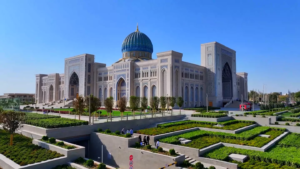
Leading international media outlets – including “CNN”, “Forbes”, “The Wall Street Journal”, “The Economist”, “Arab News” and “China Daily” – characterize the project as a “global-scale megaproject”, “pearl of Central Asia and a space that is shaping the modern understanding of Islamic civilization”.
The opening of the Center of Islamic Civilization in Uzbekistan has sparked broad international interest and has become a focal point for the world’s leading media. Publications about the Center have appeared in more than 20 countries and in 7 languages – including English, Arabic, Spanish, Chinese, Hindi, Turkish and Russian – reaching a total audience of over 1.5 billion people. These materials, prepared by international journalists, analysts and experts, reflect the high level of interest in the project from the global professional community.
International media emphasize the symbolic nature of this event. As “Arab News” notes, “the opening of the Center, initiated by President of Uzbekistan, took place during the holy month of Ramadan, just as the laying of the first stone did eight years ago, giving the project a special historical and spiritual continuity”. Meanwhile, “Khaleej Times” writes that the Center represents a “unique space where cutting-edge technology and modern scientific approaches are harmoniously combined”.
As “Forbes” notes, “under the leadership of President Shavkat Mirziyoyev, the country is implementing a strategy of sustainable development and economic openness” and amidst rapid technological changes and growing global tensions – ranging from geopolitical conflicts to discussions on cultural identity – Center of Islamic Civilization “is transforming its civilizational heritage into a modern tool of soft power”. “The Wall Street Journal” points out that the Center “unites a rich historical legacy”, highlighting its integrative function.
“China Daily” refers to the Center of Islamic Civilization as “one of Uzbekistan’s key cultural and scientific projects”, contributing to the strengthening of cultural and humanitarian cooperation between Uzbekistan and China, while “The Korea Times” notes that the complex “reflects the humanistic and enlightening essence of Islamic civilization” and “serves as a modern platform for cultural dialogue and scientific collaboration”.
“Euronews” characterizes the Center as a “new hub for heritage and research”, bringing together scientific research, education and modern exhibition practices. The Spanish publication “ABC” notes that “Uzbekistan is reviving the legacy of the Great Silk Road”, linking the project to the region’s historical role as a center of civilizational exchange.
In turn, Hungarian publication “Hello Magyar” emphasizes that “the complex’s architectural concept is impressive not only for its grandeur but also for its full compliance with modern urban planning and environmental sustainability standards”, noting its architectural expressiveness and alignment with contemporary sustainable development requirements. The Turkish publication “Yeni Konya” characterized the Center of Islamic Civilization as a “monumental and majestic center that can be considered one of the most important historical, cultural and artistic achievements of the Islamic world in the last century”.
In Azerbaijani media, specifically the publication “Caliber.az”, Center of Islamic Civilization in Uzbekistan has been described as a “candidate for the Guinness World Records”, highlighting its immense scale and uniqueness.
Center is becoming more than just a new museum; it is part of a broader narrative – a story of how countries rediscover their heritage and make it accessible to the world. Today, the Center is already open to visitors. Experts also note the Center’s potential influence on the development of cultural tourism. This new complex is capable of becoming a key attraction for international visitors, strengthening interest in Uzbekistan as a destination with a unique historical and intellectual legacy. However, judging by the attention from the global press, its significance extends far beyond tourism.